

I know a lot of software engineers who are very good at their jobs. Some have 14 or 15 years behind them. They can design a system and argue about boundaries and data flows. And they still feel they haven’t got a grip on AI.
It isn’t that the skills aren’t there. AI is a huge area with many branches, and most of what’s written starts somewhere that makes no sense yet. “Let’s learn RAG.” Fine, but if you don’t yet know what a model actually is, how context works, or what a harness does, you won’t know how to use RAG, and more importantly you won’t know when not to.
So I’m going to do it differently. I’m not trying to cover every branch of AI. I want to give you a direction, and the areas that are useful for building in 2026.
Start from what you already use. Nearly all of us use AI already. ChatGPT, Claude, Gemini. If you write code, Claude Code or GitHub Copilot. At work, maybe Microsoft Copilot 365 or Cowork. You’ve seen what they can do. That’s a good starting point, and I’ll keep coming back to things you’ve already noticed: why a long chat gets worse, why you keep seeing “compacting conversation”, why switching models halfway through feels different.
Where we’re going. Roughly in this order:
- What a model is, and what the application around it is. ChatGPT is not the same thing as the GPT model behind it, and Claude.ai is not the same thing as Claude.
- The vocabulary: model, harness, agent, product. What LangChain, Microsoft and Anthropic each mean by them, and what it comes down to for you.
- A look inside: context, compaction, hallucination and a few surprising behaviours. For the advanced bits I’ll give you the intuition and a link to a trusted source, not a deep dive.
- Extending the AI you already have: skills, tools, MCP, knowledge and memory, then subagents. And you build something small.
- Your own harness, for your own use case: frameworks versus harnesses, agent loops, state and durable execution, and when not to use an agent at all.
- Retrieval, and going beyond text: voice, images, and a call centre end to end.
- More than one agent, and the protocols between them.
- All of it as a distributed system: boundaries, retries, idempotency, stateless versus stateful.
- Governance and security. This starts on day one, not at the end.
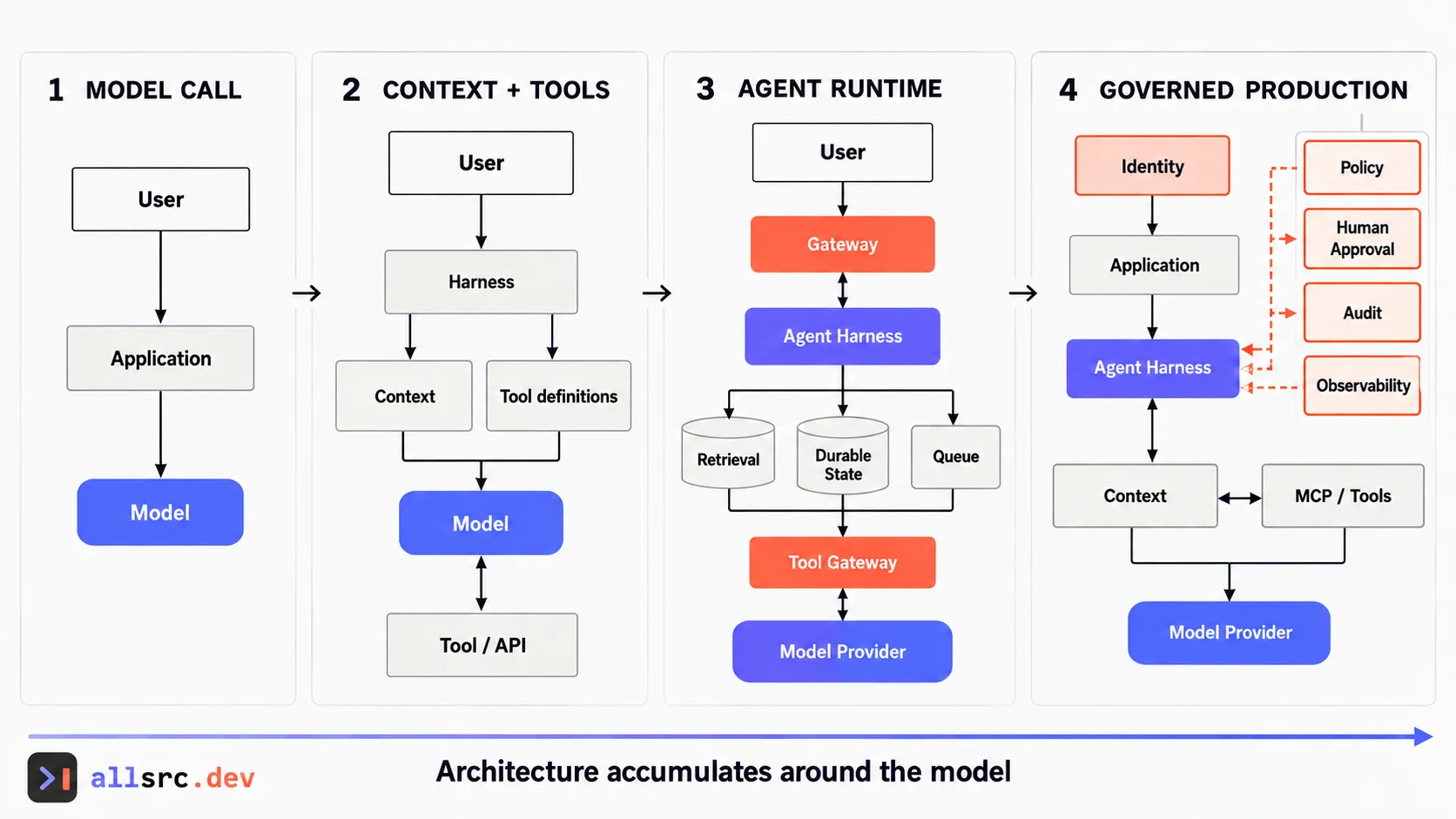 The model stays one component while the architecture around it grows.
How to read it. In order, one article at a time. It might take hours or days, and that’s fine. Each article starts from something you’ve seen, asks the question before answering it, ties the idea to something you already know from system design, and says when not to use it. Where the details change fast, I’ll point you to the provider’s docs instead of copying numbers, because this field moves every month.
First up: what is the difference between ChatGPT and the model behind it?